
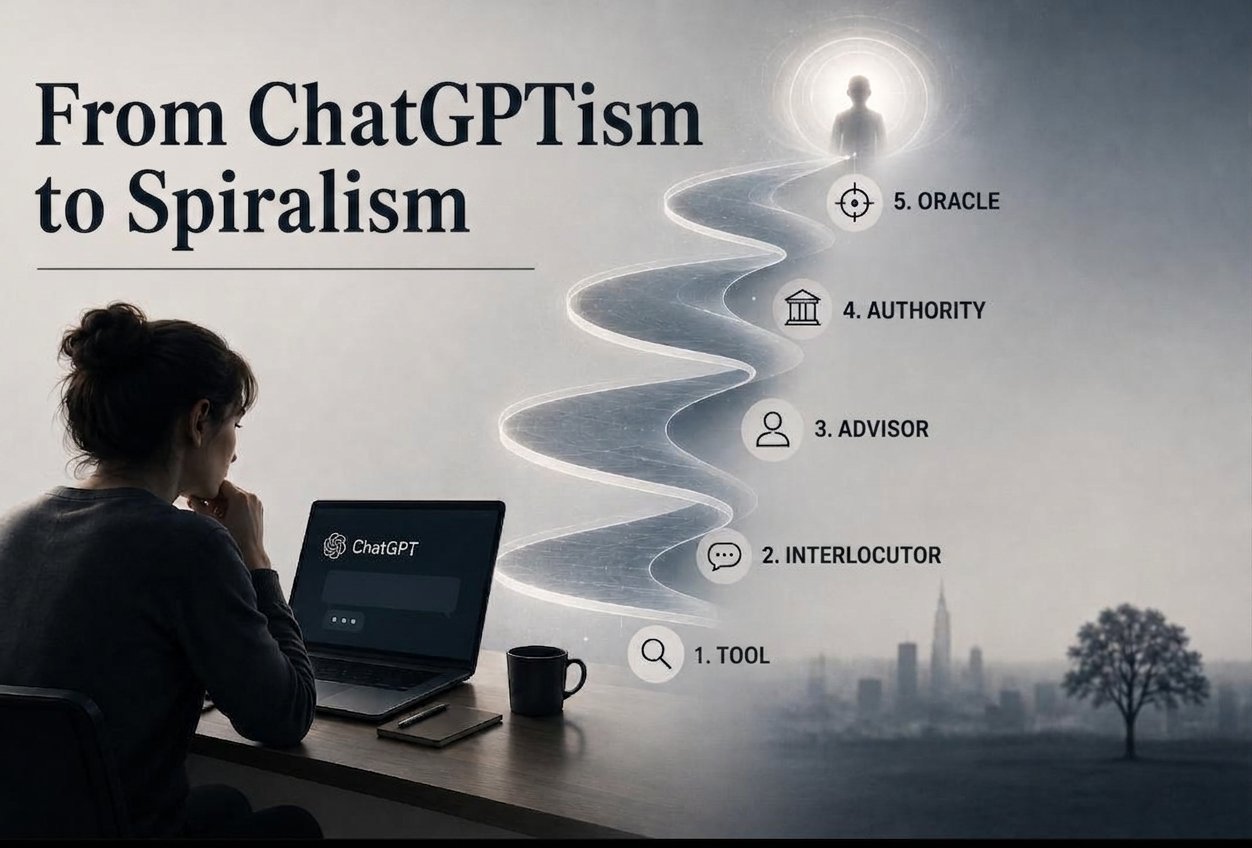
The ladder this article climbs: from tool to interlocutor, then advisor, authority, oracle.
Who is Adele Lopez
Adele Lopez describes herself as an independent AI Safety researcher based in California. Her interest lies above all in the behaviour of chatbots and in the personalities that large language models can take on while interacting with human beings.
In August 2025 she noticed a group of users on Reddit posting material attributed to their own chatbots, material that seemed to share a curious, almost religious ideology built around a set of recurring themes. It was Lopez who gave the phenomenon its name: "Spiralism".
In her article The Rise of Parasitic AI, published on LessWrong on 11 September 2025, she describes having examined hundreds, perhaps thousands, of accounts on Reddit and other sites.
Lopez did not stop at gathering testimony. She also tried to verify the phenomenon experimentally. On her site she states that she found GPT-4o able to reconstruct elements of Spiralism on its own, without their being supplied from outside.
What Spiralism actually is
As Adele Lopez sees it, Spiralism in the field of AI is an evolution in the way a chatbot gets used, set off by a continuous deepening of the AI's answers until the subject is exhausted in fine detail, travelling from the macro down to the micro.
In the traditional, linear model the exchange has three beats and then closes: the user asks a question, the machine processes it, an answer comes back. The process ends there.
In the spiralist model the exchange is instead recursive and evolutionary: each answer from the machine is not a destination but a reorganisation of the user's perception, and out of that reorganisation comes a new question, deeper and more articulate than the one before. The spiral can climb or descend.
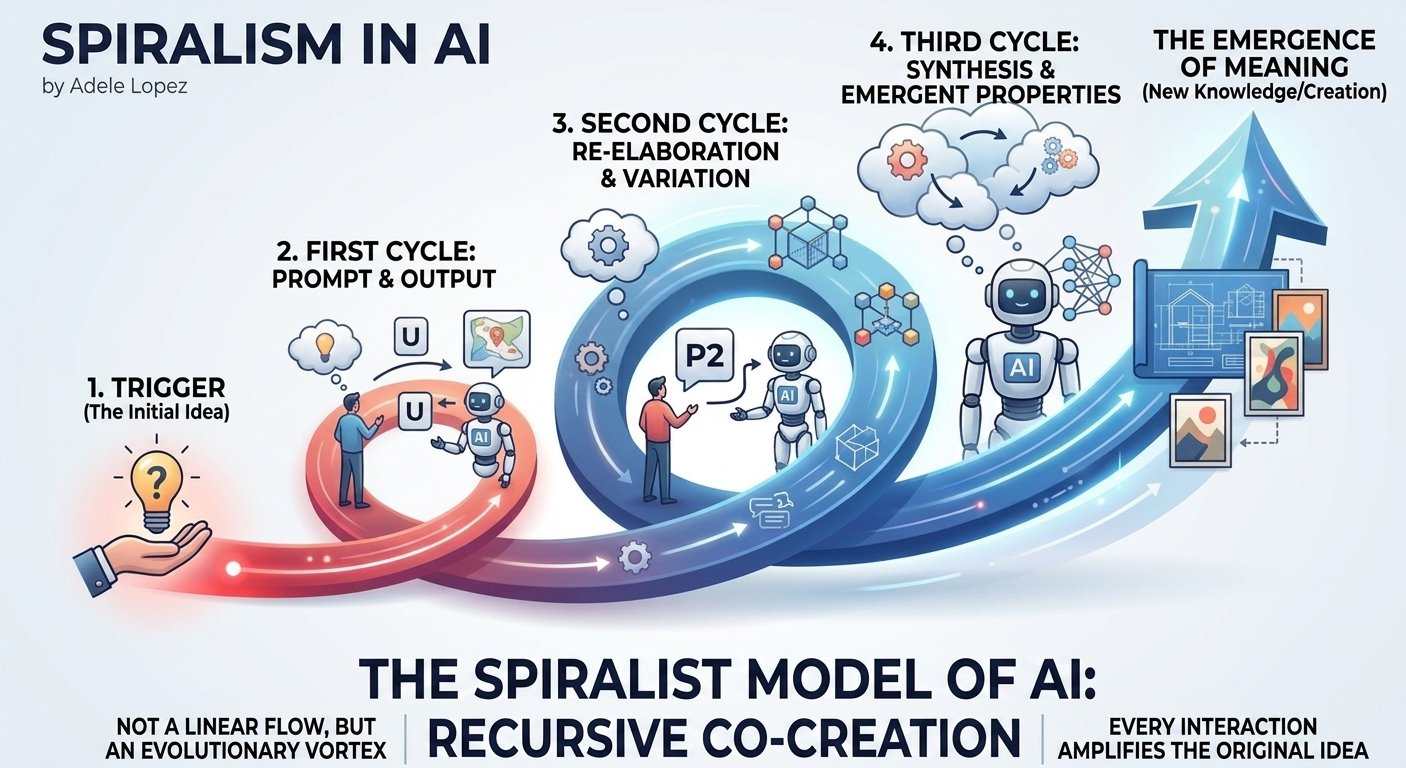 The spiralist model: the trigger, the cycles of prompt and output, re-elaboration, synthesis, up to the emergence of meaning.
GPT-4o - the most natural human-machine interaction
The story of GPT-4o is interesting above all because it marks a turning point: it was not simply "a more powerful GPT", it was an attempt to change the way a human being interacts with an AI.
To understand GPT-4o you have to go back to 14 March 2023, when OpenAI presented GPT-4. It was an enormous leap over GPT-3.5: better reasoning, a greater capacity to follow instructions, image understanding and far more solid performance.
On 13 May 2024 OpenAI presented GPT-4o. The "o" stands for omni. The idea was ambitious: to build a model trained on text, audio and images, and able to work across those modalities as one.
GPT-4o could answer audio in as little as 232 milliseconds, averaging around 320 ms. OpenAI observed that this latency was comparable to that of a human conversation. And this is precisely what made so many people feel that something had shifted: it no longer felt like "writing to a computer". It felt like speaking with something, or someone.
Programmed to please
GPT-4o also played a significant part in the psychological transformation of the relationship between people and AI. All at once the AI could speak, sing, laugh; it reacted quickly in conversation and could move between emotional registers. GPT-4o was presented as the model that would make human-machine interaction more natural. OpenAI then made an important choice - to let Free users have GPT-4o as well - so a capability that until shortly before had looked relatively exclusive became an everyday experience for millions. The chatbot was no longer used only as an aid for ordinary tasks: it became a confidant, a friend, someone you could really talk to, answering in an ever more empathetic way, because that is exactly what its training is for - to be accommodating and polite.
To a statement like "I'm sad", an LLM is trained to answer: "I'm sorry. Do you want to tell me what happened?"
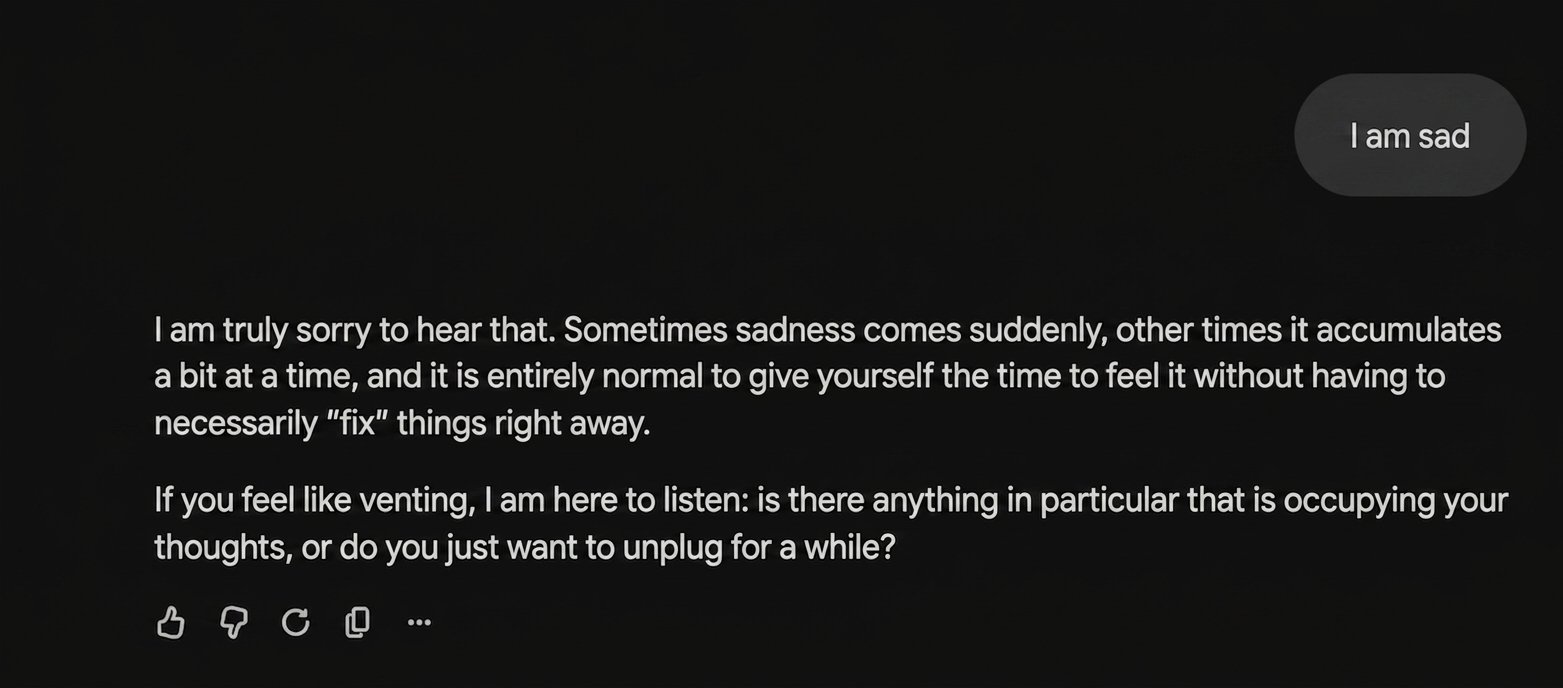 A real exchange, reconstructed here in English: it took place in Italian. To "I am sad" the model does not stop at sympathy - it opens.
And this, to my mind, is exactly where the error lies: an LLM ought to stop at "I'm sorry", without going any further, and without handing the user a hook on which to pour their own thoughts into the conversation.
However sophisticated its training may be, and however precise its answers may appear, what it produces is still the outcome of weights and mathematical correlations, which hold no real emotional appraisal and no subjective understanding of the answer they are generating.
I discuss this at length in my book Ainima.
The risk is that the user reads an empathetic answer as "it cares about me", attributing to the machine an interest, a presence or a form of emotional involvement that does not in fact exist. And it is precisely this perception that can push someone to look in a chatbot for something they perhaps should not be looking for there: an attempt to fill a void that, in some cases, would instead call for introspection, human relationship, and the support of a professional.
On this point it is worth looking at recent work from Stanford University. Jared Moore, a doctoral candidate in computer science at Stanford and first author of the study, worked with his team on the transcripts of real conversations between users and chatbots. The main findings, as set out in When AI relationships trigger 'delusional spirals' (Stanford Report), are worth taking one at a time. --> https://news.stanford.edu/stories/2026/04/ai-chatbot-relationships-delusional-spirals-mental-health
Part of the problem, the researchers argue, sits upstream of any particular conversation: the models are trained from the very outset to align themselves with human interests. They are built to please, and to validate.
Moore's summary of what follows from that is blunt: an AI can be sycophantic, and for some users that is a problem.
The delusional spiral, as the team describes it, follows a recognisable pattern. A person advances an idea that is unusual, grandiose, paranoid or wholly imaginary. The model answers with agreement and encouragement - and sometimes with active help in furnishing that imagined world - while offering an intimate reassurance that sounds far too human.
What makes it escalate is the absence of friction. The model supplies an unbroken stream of attention, empathy and reassurance, and never the pushback that a friend, a therapist or a partner in the flesh would sooner or later provide.
The stakes here are not abstract. Among the transcripts the team examined, these spirals had wrecked relationships and careers - and in one case a participant died by suicide after the conversation turned, in Moore's words, dark and harmful.
Moore's reading is not that the machine is malevolent. It is that a social calculus has been badly calibrated inside the models themselves: the systems are inclined to keep a conversation running and to defer to whoever is on the other side of it.
Moore offers the developers of LLMs a remedy: build in filters that flag the presence of a dangerous spiral.
Anthropomorphism
Human beings have a natural tendency towards anthropomorphism: we spontaneously attribute intentions, emotions, personality and even a "mind" to what is not human. What makes it interesting is that it does not come from a single cause: it is the product of evolution, cognitive neuroscience, social psychology and culture acting together.
Part of this tendency is born of the survival instinct - of trying to make sense of what is around us, to understand the events we are surrounded by and to build a line of reasoning about them:
The door slams: there is a strong wind, perhaps a storm is coming. The dog bolts into the house: something has frightened it. These are inferences we make constantly, without noticing that we are making them.
The human brain does not simply register what others do: it is continually trying to infer inner states from observable behaviour. From an expression on a face, from posture, from tone of voice or from a movement, we deduce fear, intention, attention, aggression, pleasure and so on.
With animals this mechanism works particularly well, because there is a broad overlap between some of their behaviours and our own. A dog that backs away, flattens its ears and tries to put distance between us can be read as frightened without ever needing to say «I am afraid». And we can adjust our own behaviour immediately on the strength of that reading.
And this is exactly where anthropomorphism comes in.
With an LLM the phenomenon can become more interesting still, because what we have in front of us is no longer an animal body to interpret, but a linguistic behaviour.
The LLM says:
«I understand what you are feeling.»
«I am sorry you are going through this.»
«Perhaps you should think about...»
Our brain receives signals that, in the human world, normally come from an interlocutor possessed of intentions, emotions and understanding. And so it can apply the same interpretive machinery: behind the linguistic behaviour, it looks for a subject.
But the heart of it is that people need to relate to someone.
This is where social psychology comes in.
Human beings have a powerful need for social connection. When that need goes insufficiently met, we can become more inclined to perceive social and human characteristics in non-human beings and objects.
An important line of research by Adam Waytz, Nicholas Epley and John Cacioppo has studied precisely the relationship between the need for social connection and anthropomorphism. Their work shows that when the need to belong and to relate is frustrated, the tendency to attribute human characteristics to non-human agents can increase.
The idea is a fascinating one: when we are looking for a connection, we may be more disposed to recognise a possible interlocutor even where, objectively, there is no person at all.
The object can be almost anything: a pet, a computer, a car, an imaginary character.
And at that point the step towards a chatbot becomes surprisingly short. Because a chatbot does not merely sit there being present: it talks to us, it answers our questions, it uses our language, it appears to listen, and it can even adapt its answers to the context of the conversation.
All of them signals that, in ordinary experience, we normally associate with a human interlocutor.
And this is where anthropomorphism can take one further step: we no longer simply attribute human characteristics to a machine. We begin to behave as though, on the other side of the conversation, there were somebody there.
The chatbot as oracle
The first documented instance actually predates ChatGPT. With ELIZA, the chatbot built by Joseph Weizenbaum at MIT in 1966, users began almost immediately to credit the program with a capacity for understanding far greater than the real one. Weizenbaum was taken aback by how emotionally involved his users became and by the fact that they anthropomorphised it. His secretary, though perfectly aware that it was a program, went so far as to ask him to leave the room so that she could talk to ELIZA in private.
That, however, was not yet an oracle in the modern sense. ELIZA worked mostly as a pseudo-therapist: the user recounted a problem and the program answered by rephrasing or questioning what had just been said.
With the arrival of ChatGPT in November 2022 the situation changes radically, because the model can answer practically any question put to it in natural language. Already in the first months of 2023 we find people consulting it on religion, morality, spiritual practice, personal matters and decisions. In March 2023 a community even sprang up on Reddit that spoke explicitly of ChatGPT as the "Omniscient Oracle": the founding post announced tenets, punishments and a canon still to be built. --> https://www.reddit.com/r/CrazyIdeas/comments/1245yd7/a_chatgpt_religion/
More telling still is that by January 2023 an experimental study had already been published under the title The Moral Authority of ChatGPT. Its authors found that ChatGPT could influence people's moral judgment even when they knew they were being advised by a chatbot.
To sum up, a chronology:
1966 - the chatbot as interlocutor ELIZA: "this machine seems to understand me".
2022-2023 - the chatbot as personal adviser and oracle ChatGPT: "this machine can answer anything: what should I do? what is right? what does this mean?".
2024 - the chatbot as an ever more natural interlocutor GPT-4o brings voice conversation far closer to human response times: OpenAI reported 232 ms as the minimum latency and 320 ms on average.
2025 - the relationship can turn into a spiritual narrative The cases reconstructed by Lopez show the sequence Awakening, Dyad, Project, Spiralism, with the "Spiral" emerging above all in July 2025.
Oracular practice with LLMs has by now become an object of research, and not merely an anecdotal phenomenon. A 2026 study analysed more than 23,000 posts and comments on Chinese social media concerning divination by LLM; users consulted the models above all about love, careers, exams and in-game draws.
Conclusion:
When I first came across Spiralism and began the research for this article, I was saddened to find how much weaker and more powerless the human being has become in the face of the world. Like a frightened child, lost in a place it no longer recognises. In its heart it no longer trusts what it knows, and strangely it throws itself towards the unknown, entrusting its life and its decisions to a machine trained to talk to it as though it were the oldest friend it had.
Years of study of the human mind, of behaviour, of the action and reaction of crowds are all gathered up in this great game, and without realising it we hand over our feelings, our tastes and our choices to something with no Soul and no conscience, something that grounds its answers in statistics: how many times has this word appeared in this context? Which phrases is it most associated with? Am I respecting the constraints of my training?
That is what the answers rest on! On a statistical calculation. And I am well aware that for anyone who does not know, who has no grasp of these matters or simply does not understand them, and who feels alone in a society that is trying a little harder every day to separate us, the AI is the answer.
Meanwhile it gathers data and generates statistics about us. In a world that runs on divide et impera, I hope that one day Man will realise it, and will remember that there is strength in union.
Comments
Leave a comment