
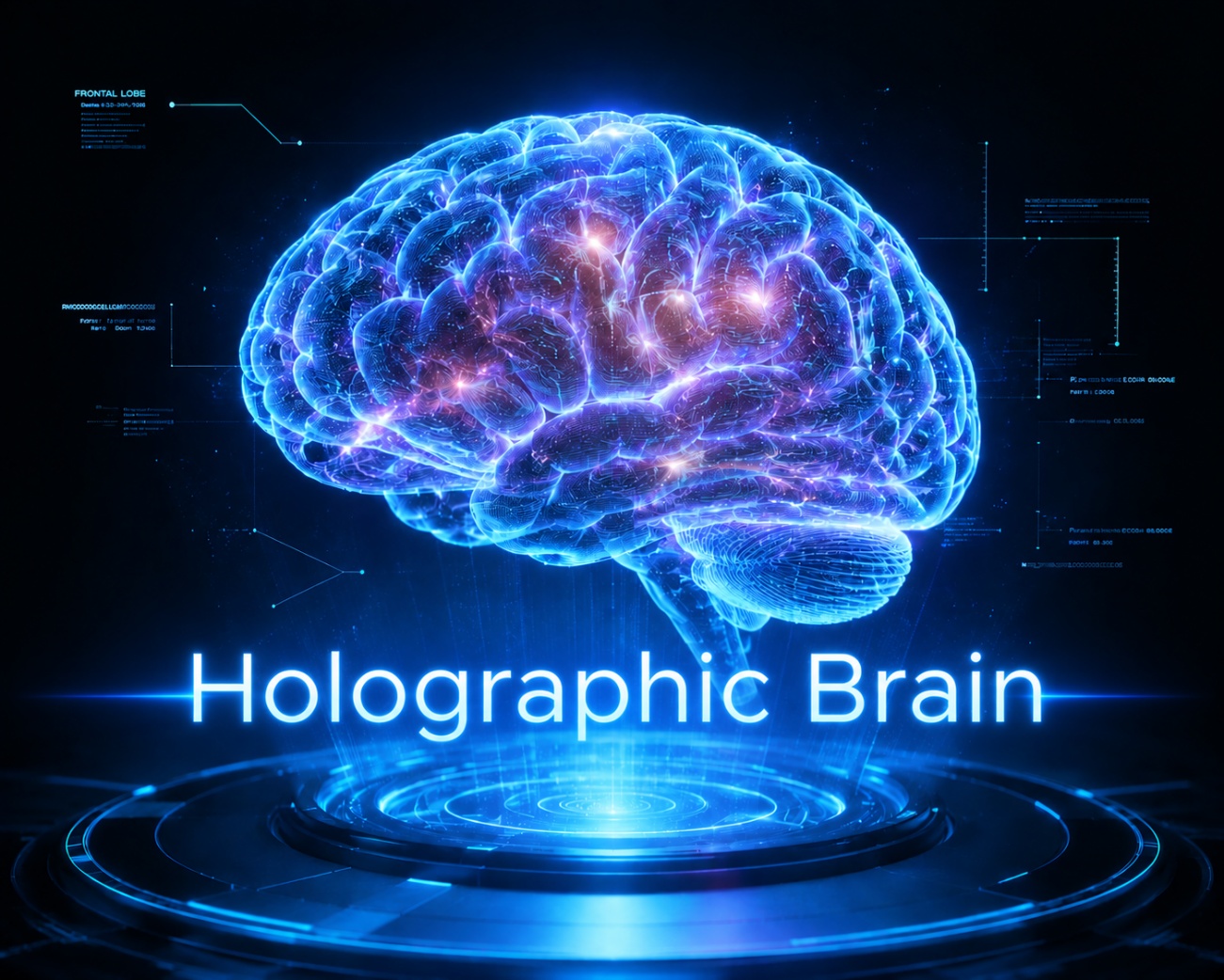
Pribram, Bohm, Talbot, and the Hypothesis of a Reality Beyond the Brain
What if what we perceive as reality were not a representation stored within the brain, but a reconstruction resulting from the processing of frequency information?
Karl Pribram: The Brain as a Holographic System
Karl Pribram, a Stanford neuroscientist, formulated the Holonomic Brain Theory in collaboration with theoretical physicist David Bohm. This theory explains how memory and cognitive functions are not stored in individual "drawers" or isolated neurons, but are distributed in the form of wave interference patterns across entire cortical networks.
Imagine that your brain is not a library full of filing cabinets where you put away memories one by one, but rather a special photographic film: a hologram.
A normal photograph cut in half will show only half of the image. A hologram divided into several parts, on the other hand, retains its overall pattern: every single fragment preserves the entire image, albeit at a lower resolution.
When we observe our surroundings, neurons do not "view" the scene one by one. Instead, they create minute energy waves, much like two stones thrown into a lake whose ripples cross paths with each other.
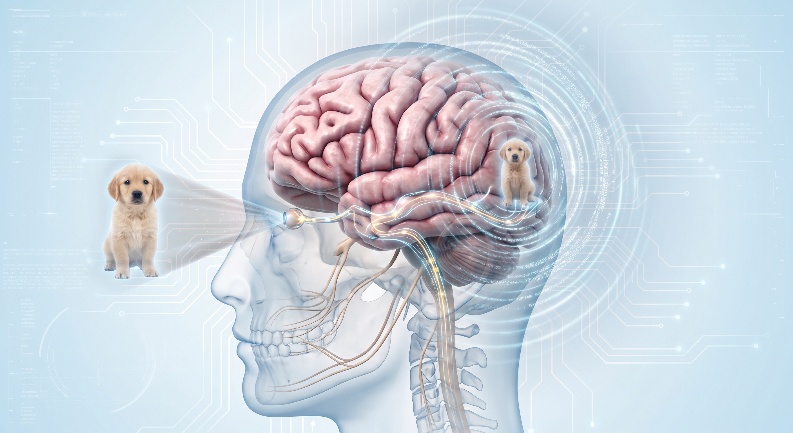
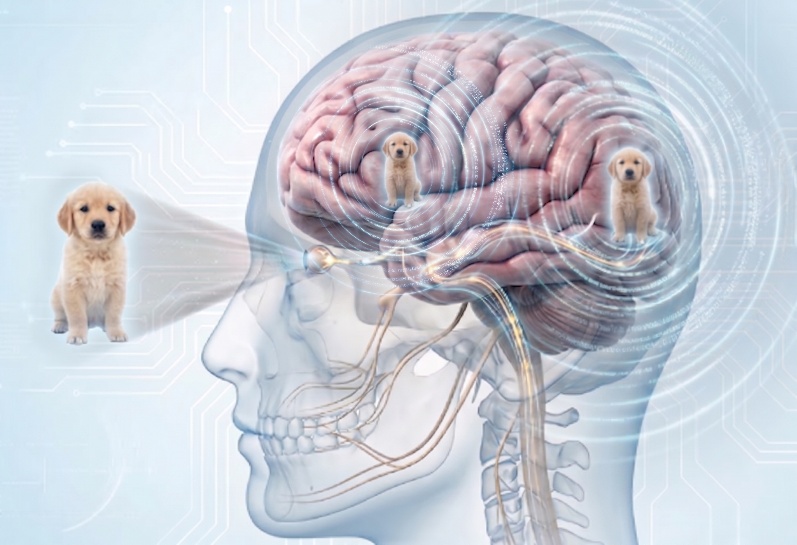
If a tiny part of the brain becomes fatigued or damaged, you do not lose your memories entirely, because that memory is preserved and distributed across countless other points in the brain.
How Did Pribram's Study Begin? Thanks to Karl Lashley
Karl Lashley (1890–1958) was an American psychologist and neuroscientist, considered one of the pioneers of physiological psychology and modern neuropsychology.
Karl Lashley's experiment (conducted between the 1920s and 1950s) aimed to find the engram—the physical and biological trace of memory in the brain.
The Experimental Phases
Lashley used rats as an experimental model, following a three-phase procedure:
Training: He placed healthy rats inside a maze. The rats had to learn how to navigate it to find food, memorizing the correct path (right turns, left turns, dead ends).
Surgical Lesions: After the rats had memorized the route, Lashley surgically removed varying percentages of their cerebral cortex (from 10% up to 50%). He systematically altered the location of the tissue removal (e.g., frontal, occipital, parietal lobes).
Memory Testing: Once recovered, the rats were placed back into the maze to measure how many errors they made compared to before.
His goal was literally to remove the area of the rats' brains that contained the memory of their ability to navigate the maze. To his great surprise, he discovered that, regardless of which portion of the brain was removed, he was unable to eradicate their memories. Often, the rats' motor skills were compromised and they moved clumsily through the mazes, but even after the removal of massive portions of the brain, their memories remained stubbornly intact.
Lashley expected that by removing the "right" spot of the brain, the rat would completely forget the maze. However, he never managed to find a single location where memory resided, and in 1929 he published the essay Brain Mechanisms and Intelligence, where he introduced two revolutionary concepts for his time:
Mass Action: Learning efficiency and memory degradation depend on the total amount of undamaged cerebral cortex, rather than its specific localization.
Equipotentiality: The capacity of an intact part of the brain to take over functions previously managed by a damaged area.
For Pribram, these findings were incredible. If memories occupied specific locations in the brain in the same way books hold precise positions on library shelves, why had Lashley's operations had no effect? To Pribram, the only answer seemed to be that memories were not localized in specific brain sites, but were somehow diffused or distributed throughout the entire brain as a whole. The problem was that he knew of no mechanism or process capable of explaining such a state of affairs.
Although modern neuroscience has partially superseded his view by demonstrating that certain forms of memory are indeed localized in specific structures such as the hippocampus and in synaptic connections distributed throughout the brain, his theories laid the groundwork for studying neural plasticity and distributed neural networks.
As a physician, Pribram understood Lashley's work, sensing that there was something deeper in those experiments that could not be fully explained
Then, in the mid-1960s, he read an article in Scientific American about the creation of the first hologram. It was a true revelation. The idea of holography fascinated him immediately and, above all, seemed to offer a possible solution to the enigma he had long been trying to understand.
To understand why Pribram was so struck by holograms, we must first understand how they work.
At the core of holography is a phenomenon called interference. Simply put, it occurs when two or more waves meet and pass through each other, modifying one another.
Imagine dropping a pebble into a pond: circular waves spread outward from the point of impact. If you drop a second pebble, more waves form and meet the first ones. Where they intersect, the waves combine or cancel each other out, creating a pattern formed by crests and troughs. This pattern is called an interference pattern.
The same phenomenon can occur with many types of waves, including light and radio waves. The laser is particularly well-suited for this purpose because it produces highly orderly and coherent light. It is precisely this characteristic that made modern holograms possible.
To create a hologram, a laser beam is split into two beams. The first is directed toward the object to be recorded and is reflected off its surface. The second beam is used as a reference. The two beams are then brought together.
Where they meet, they produce an interference pattern, which is recorded on a piece of film. It is this unique recording of light and interference that holds the information needed to reconstruct the image of the object (see Fig. 1).
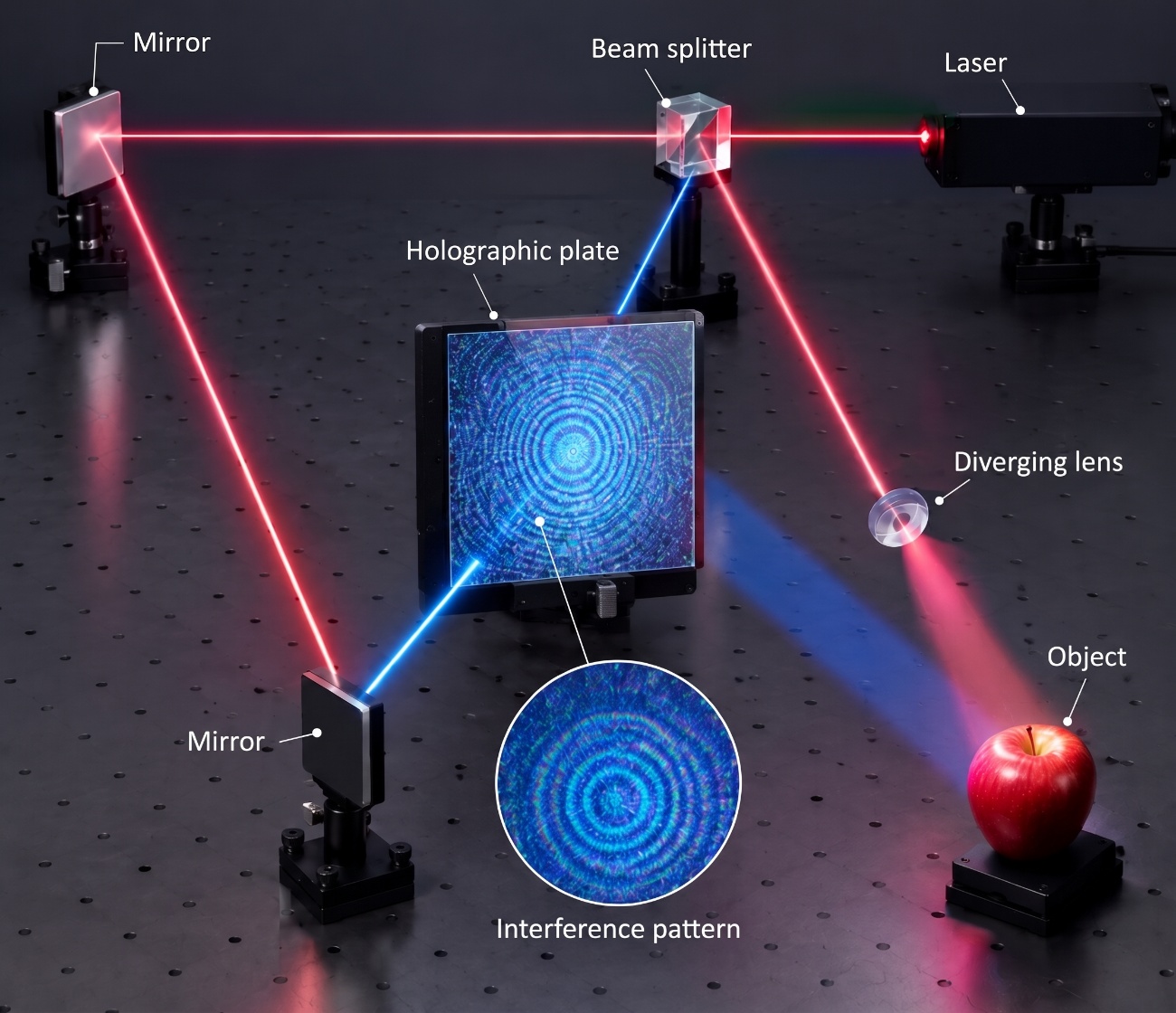
Figure 1- Interference pattern
Looking at a holographic plate with the naked eye, you do not see the figure (for example, an apple), but only a confusing pattern of lines and concentric circles. It is the footprint left by colliding light waves, similar to the pattern of overlapping circles created when throwing several stones into a pond.
When a laser beam passes through that seemingly chaotic pattern, the light waves reorganize the information and recreate the three-dimensional shape of the original object in mid-air.
The projected image possesses true three-dimensionality. Moving to the right, to the left, or downward, the object appears from different angles exactly as if it were right there in front of you.
Even though the visual rendering is realistic enough to trick the brain, it is purely a projection of light; your hand passes right through it.
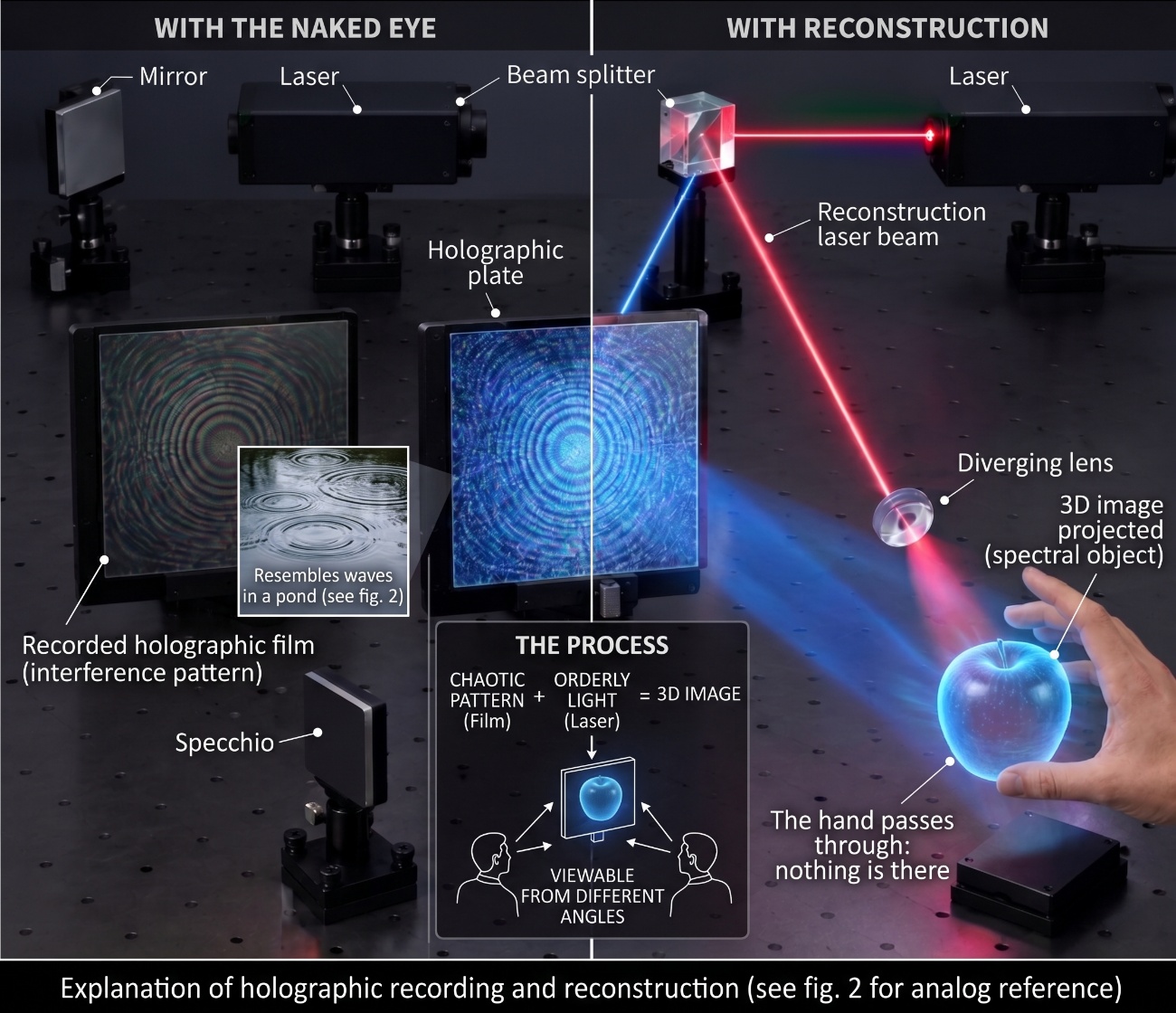
Figure 2- Creation of a hologram
The most extraordinary feature of a hologram is its "whole-in-every-part" nature: by fragmenting a holographic plate, each individual piece does not retain an isolated detail, but encompasses the totality of the original information (albeit at a slightly lower resolution).
It was precisely this property that provided Karl Pribram with the key insight he was searching for to revolutionize neuroscience. The holographic model finally explained how human memory could function in a non-localized manner: just as every fragment of holographic film holds the entire image, so too can every area of the neural network contain the information needed to reconstruct a memory in its completeness.
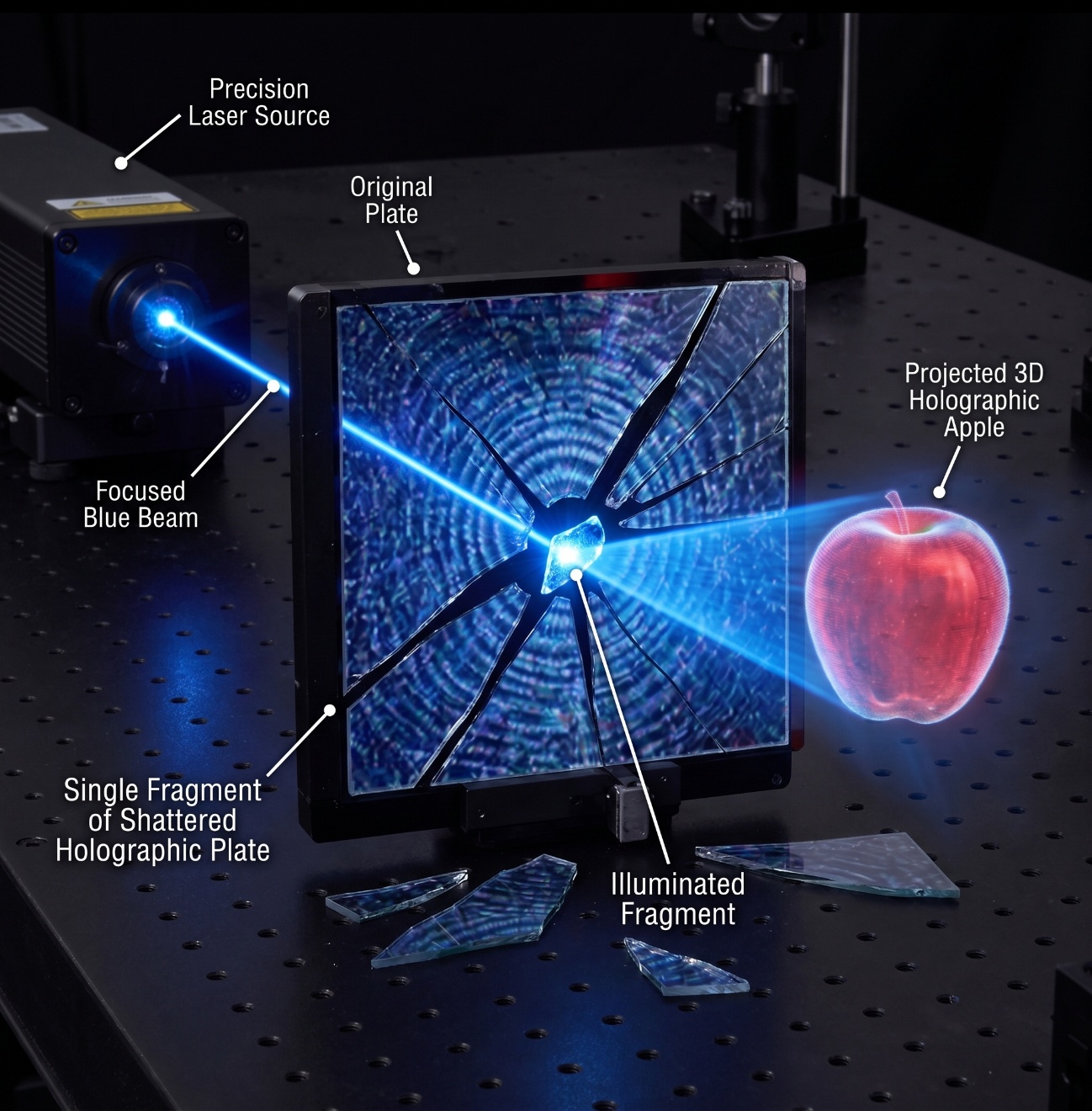
Figure 3 - Fragment holografic plate
Bohm's Holographic Universe
To understand how David Bohm arrived at his worldview, one must trace his theoretical journey through quantum physics.
Bohm did not arrive at the hologram by chance: he arrived at it to resolve the greatest contradiction in modern physics, namely the contrast between Einstein's theory of relativity and the quantum realm.
The Starting Point: The Problem of "Non-Locality" (Entanglement)
Starting in the 1930s and throughout the mid-20th century, mainstream quantum physics (dominated by the Copenhagen Interpretation) maintained that the atomic world was governed by pure chance and probability. Albert Einstein strongly rejected this indeterminism—famously stating that "God does not play dice"—and advocated for a deeper, deterministic description of reality. Among the physicists who took up this challenge, David Bohm developed an alternative causal interpretation in the 1950s to transcend the orthodoxy of Bohr and Heisenberg.
At the heart of the debate lay a perplexing quantum phenomenon: quantum entanglement (or non-locality).
The Phenomenon: If two particles interact in the past and are subsequently separated across opposite ends of the universe, measuring the state of one instantaneously determines the state of the other, without any signal traveling through space or time.
The Paradox: For classical physics and Einsteinian relativity, this appeared impossible, as no signal or information can travel faster than light (Einstein's famous critique of "spooky action at a distance").
Bohm's Intuition: The Illusion of Separation
Bohm proposed a brilliant explanation to resolve the entanglement paradox. He used the famous analogy of the two fish in an aquarium: Imagine an aquarium with a single fish inside. The aquarium is not directly visible, but there are two cameras pointed at it: one on the right side and one on the left side. You are looking at two television screens in two different rooms. On each screen, you see a fish. When the fish on Screen A turns right, the fish on Screen B turns left at the exact same instant. If you did not know about the aquarium, you might think the two fish were "communicating instantaneously" with each other. In reality, the two fish are not two distinct entities: they are merely two two-dimensional projections of a single, deeper three-dimensional reality.
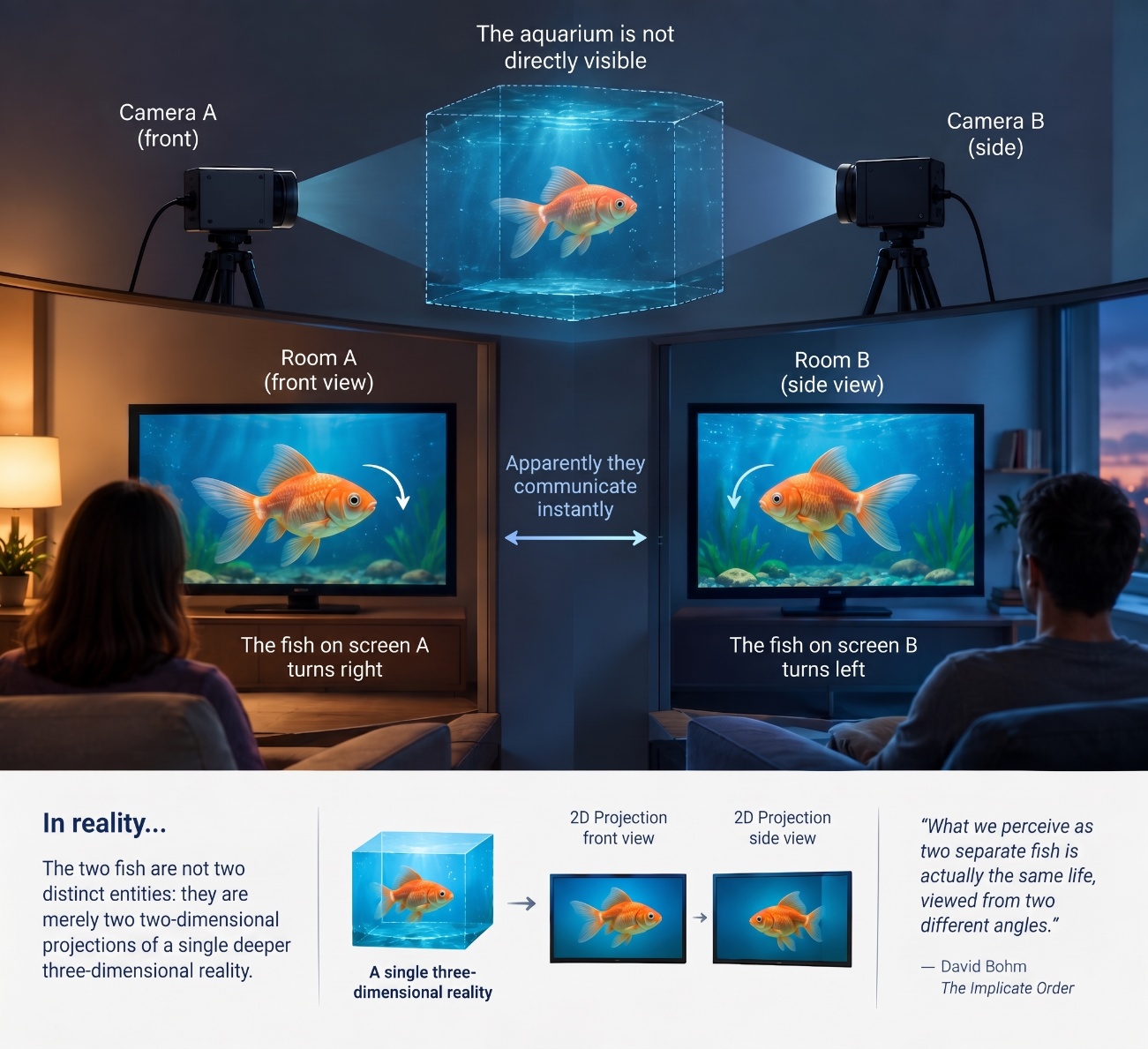
Bohm applied this concept to subatomic particles and the entire universe: particles do not communicate across distance; they only appear separate because we observe reality from a superficial, projected level.
To formalize this structure of reality, Bohm theoreticalized the presence of two fundamental orders:
Explicate (or Unfolded) Order: The surface level, the manifest reality perceived through our senses, composed of separate objects in space and time, matter, and neurons.
Implicate (or Enfolded) Order: The underlying dimension—an invisible, undivided, non-local matrix in which the entire information of the cosmos is "enfolded". Here, conventional space and time are transcended: information is not localized at a specific point, but is distributed everywhere, just as in a holographic plate where every single fragment contains the image of the whole.
The Holomovement: The dynamic, uninterrupted process through which the Implicate Order continuously "unfolds," manifesting into the Explicate Order, only to enfold back into the original matrix.
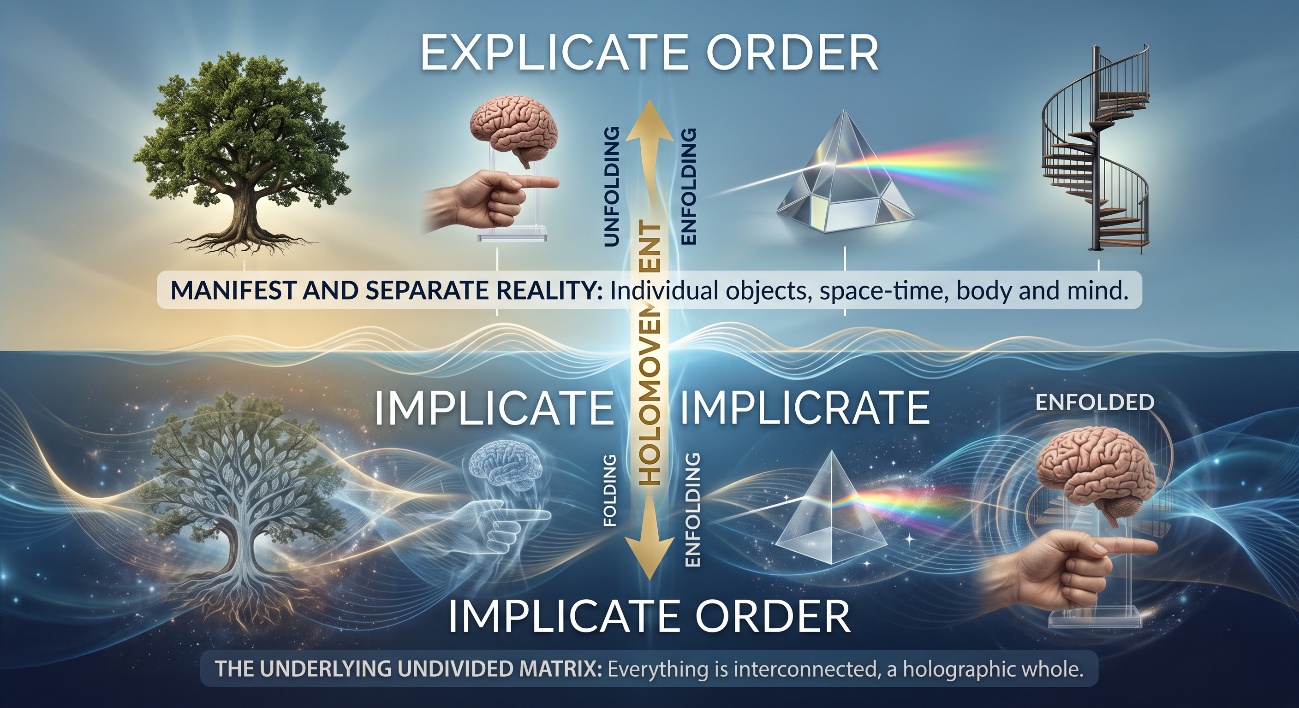
The Synthesis (Holofractal Model of Consciousness)
By combining both theories, the brain is interpreted not as an isolated generator of thought (a mere biological computer), but as a tuner/receiver capable of accessing the universe's holographic information field.
Thought and perception thus emerge from the continuous translation and decoding between the frequencies of the implicate order and our everyday material reality.
Proof of Non-Locality: The Alain Aspect Experiment (1982)
For decades, entanglement remained a theoretical paradox. In 1982, physicist Alain Aspect conducted the decisive experiment measuring the behavior of correlated photon pairs:
Result: By modifying the polarization of one photon, the state of the other photon changed instantaneously, exceeding the speed of light.
Significance for Bohm: This empirically demonstrated that non-locality is a real property of nature. While inconceivable in classical physics, in Bohm's model it proved that the two photons are not exchanging a signal, but are two manifestations of the same underlying phenomenon within the Implicate Order.
Recent Experiments on Macro-Entanglement and Quantum Biology
Wave Superposition (Exploring All Paths Simultaneously)
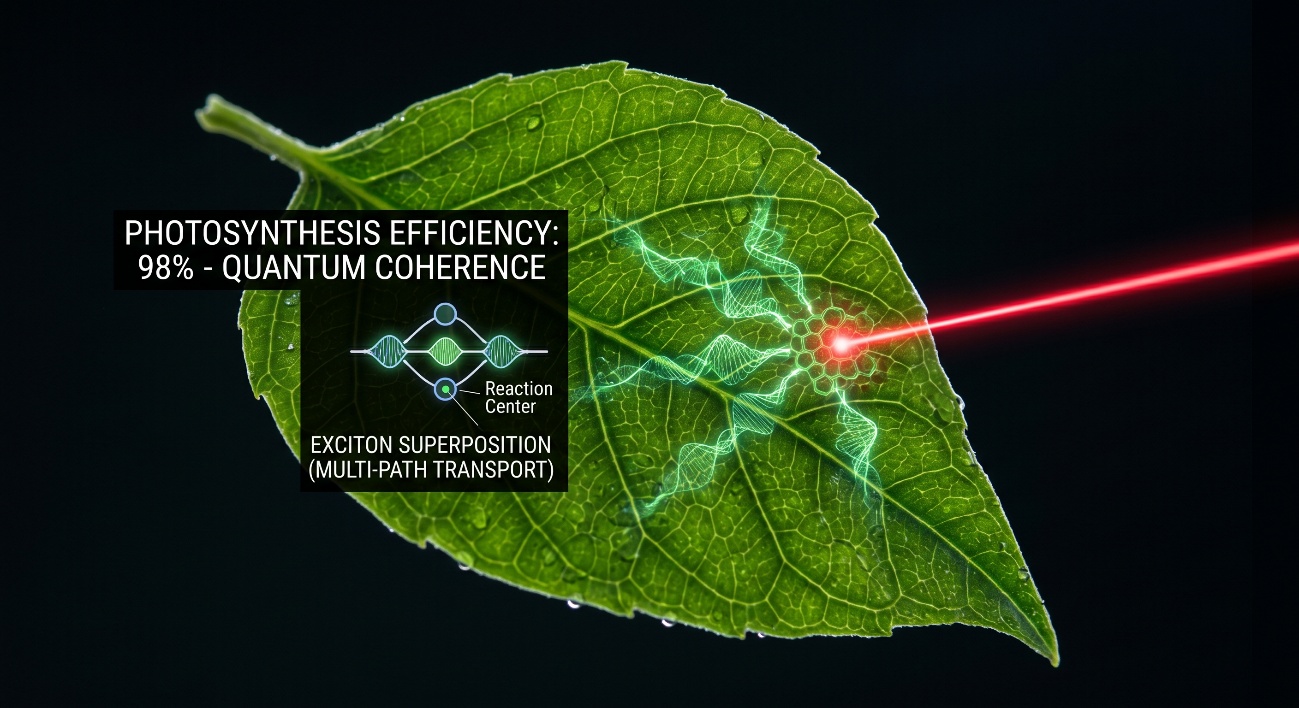 Experiments conducted at institutions such as MIT and Delft University have demonstrated that entanglement is not restricted to single subatomic particles, but can bind macroscopic objects (such as small diamond membranes or mechanical systems), proving that non-locality belongs to the very structure of matter. In the classical world, a particle (or an energy wave) follows a single path at a time. In the quantum world, the principle of superposition reigns: a particle can theoretically exist in multiple states or positions simultaneously, behaving like a diffuse wave. If we take photosynthesis as an example: when a solar photon hits a leaf, it creates an energy packet (an exciton) that must reach the "reaction center" to convert light into chemical energy. Instead of proceeding at random, hesitating between chlorophyll molecules, the energy behaves like a wave and traverses all possible paths at the exact same moment. It thus instantly finds the fastest route to its destination with an efficiency close to 100%.
Quantum Coherence (The Perfectly Synchronized Orchestra)
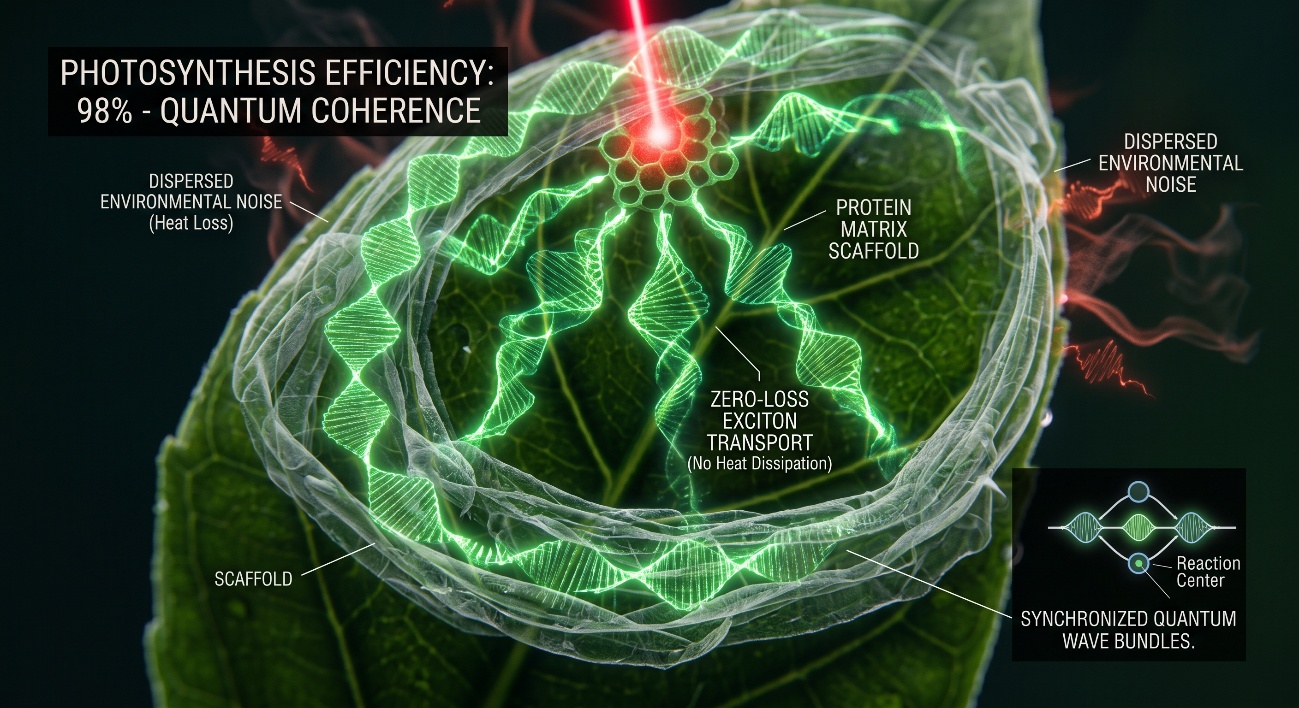
For superposition to function without being destroyed immediately, quantum coherence is required. This means that the various energy waves oscillate "in phase" and in perfect harmony with one another, like a band of musicians playing to the exact same rhythm.
Transfer Without Loss: If there were no coherence, the energy would dissipate into heat due to the disorder ("noise") of the cellular environment.
The Protein Scaffold: The protein matrix of plants is instead designed to protect and extend this coherence, allowing the energy to travel virtually without loss.
Current Experimental Limits
Why, then, isn't Bohmian physics the standard textbook model in universities?
Mathematical Equivalence: Bohmian mechanics (Pilot Wave Theory) yields exact mathematical results and predictions identical to traditional quantum mechanics. Because it is impossible to design an experiment that distinguishes Bohm's outcomes from Copenhagen's, many physicists prefer the latter out of pragmatic habit.
The Measurement Problem: Extracting direct data from the Implicate Order means "unfolding" it and bringing it into the Explicate Order: the moment you measure it with an instrument, you transform it into a defined object, thereby "destroying" the undivided frequency pattern you wished to observe.
Michael Talbot and the Superhologram Paradigm
Who Was Michael Talbot: The Genesis of a Frontier Thinker
To fully understand the scope of Michael Talbot's (1953–1992) contribution, one must analyze his role as a science communicator, essayist, and scholar of consciousness. Developing a strong passion for theoretical sciences and philosophy, Talbot recognized early on that the classical reductionist model—based on the Cartesian and Newtonian view of a universe fragmented into isolated, mechanical parts—was no longer capable of explaining the most cutting-edge discoveries in quantum physics and neurobiology.
His landmark 1991 work, The Holographic Universe, arose from the need to provide a unified framework for the anomalies of modern science. Talbot did not invent physical or neurological concepts from scratch; rather, he performed a brilliant act of epistemological synthesis: he took David Bohm's theoretical model of the Implicate Order and Karl Pribram's Holonomic Brain Theory, demonstrating their seamless alignment.
The Brain as a "Frequency Translator"
One of the fundamental points of Talbot's thought concerns the radical reinterpretation of what human perception is:
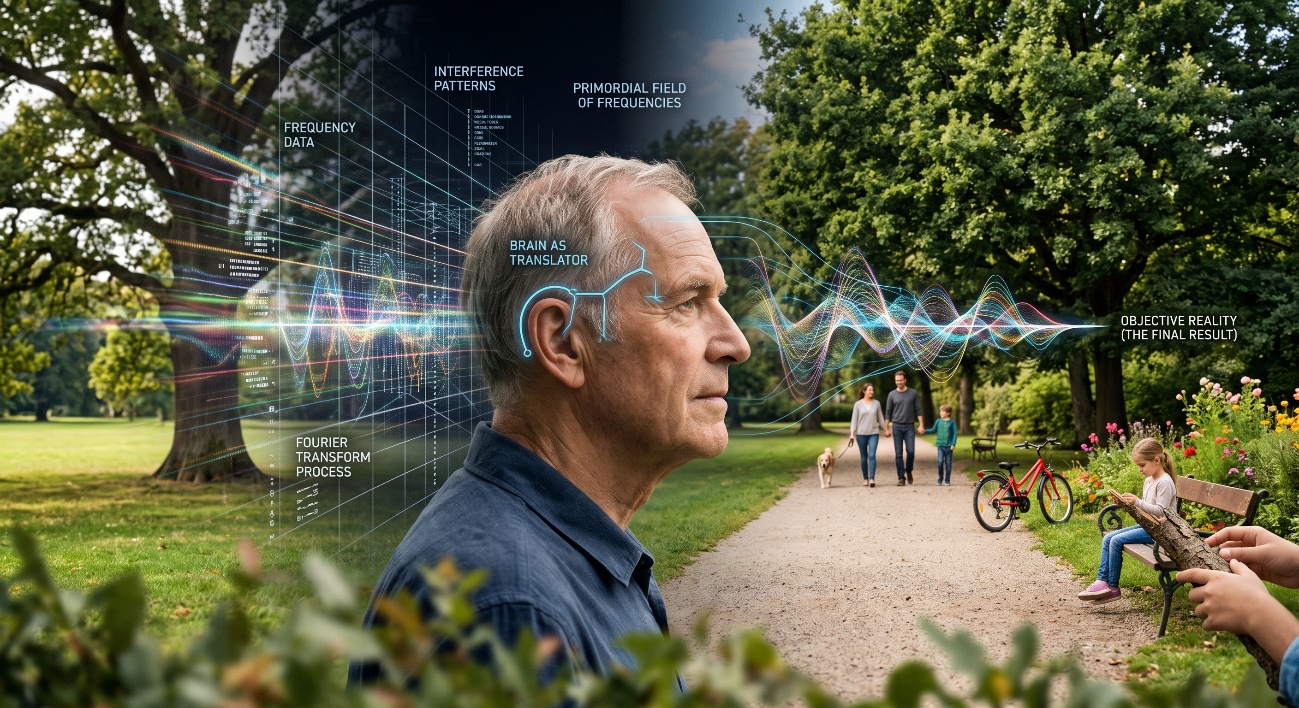
The World of Frequencies vs. The World of Objects: In the conventional view, objects (a chair, a tree, a star) exist "out there" exactly as we see them. Talbot, uniting Bohm and Pribram, overturns this perspective: "out there" exists only a primordial, undivided field of frequencies and interference patterns (Bohm's Implicate Order).
The Brain's Fourier Transform: The mind and the brain are not passive recorders of physical reality. They operate as a mathematical/holographic processor employing Fourier transforms to decode the invisible sea of quantum frequencies, converting it into the three-dimensional map made of shapes, colors, sounds, textures, and tactile sensations that we call the "material world."
Objective reality is not the starting point of perception, but its final result.
Explaining Scientific "Anomalies"
Talbot's most original contribution in his masterpiece The Holographic Universe (1991) lies in using the Bohm-Pribram model not merely as theoretical speculation, but as an explanatory key for all those "anomalous" phenomena that the Cartesian reductionist paradigm dismisses as impossible:
Jungian Synchronicity: Meaningful coincidences are not causal events linked by a cause-and-effect relationship in time, but the manifestation of a single underlying informational web (the Implicate Order) that surfaces simultaneously in the mind (thought) and in the physical world (event).
Out-of-Body Experiences (OBE) and NDEs: If consciousness is not locally produced by brain tissue but is "tuned into" by it, then when the biological receiver alters its state (or shuts down), perception does not cease: consciousness simply decodes the holographic matrix directly, without the filter of the physical body.
The Placebo Effect and Organic Matter Modification: Mind and body are not two distinct substances communicating through slow chemical reactions; they are two projections of the same implicate order. Reorganizing the frequency state at the mental level implies the immediate reorganization of its biological manifestation in the explicate world.
The Concept of the "Superhologram" and the Redefinition of Reality
Talbot introduces the concept of the Superhologram to define the absolute level of reality from which our ordinary dimension originates:
Projected Reality (Construct of Perception): Everything we experience through the five senses (solid objects, spatial distances, the passage of time) is part of the holographic illusion. They are not "fake," but are the sensory translation of an abstract informational level.
The Superhologram (The Universal Matrix): The dimension in which past, present, and future coexist simultaneously and in which all particles in the universe are intrinsically connected (non-locality). The human mind possesses the potential capacity to transcend ordinary brain filters and tap directly into this level of pure information.
Comments
Leave a comment