
If you strike a tuning fork and bring it close to a second tuning fork tuned to the same frequency, something remarkable can happen: the second fork will begin to vibrate spontaneously, without ever having been touched. This phenomenon is known as sympathetic resonance and represents a manifestation of acoustic resonance.
When two oscillating systems have compatible frequencies and are sufficiently coupled, one can influence the behavior of the other, encouraging it to respond through vibration. This phenomenon spans many areas of physics, from music to electromagnetic waves.
But what happens when we shift our focus from musical instruments to the human brain? Our neural activity also exhibits rhythms and oscillations that can coordinate and synchronize through complex interactions.
Could there be a connection between these brain rhythms, our state of consciousness, and the way we perceive the world? To explore this possibility, we must enter the territory where neuroscience, the physics of oscillations, and the study of consciousness converge.
1. The Physics of Resonance and Biological Rhythms
In 1665, the physicist Christiaan Huygens observed that two pendulum clocks hanging on the same wall would eventually synchronize the movement of their pendulums, swinging in unison. This phenomenon of rhythmic coupling permeates the natural world: from fireflies flashing simultaneously to circadian rhythms regulated by sunlight.
Our bodies are no exception. Every organ, tissue, and biological process has its own vibrational signature. When exposed to constant acoustic or rhythmic stimuli, the nervous system does not simply listen or passively perceive: it seeks a point of alignment and adapts to the dominant rhythm.
2. Neural Entrainment: How the Brain Responds to Frequencies
The human brain is characterized by constant electrical activity. Billions of neurons communicate through electrochemical signals, and when groups of neurons coordinate their activity, they can generate rhythmic oscillations that can be measured using electroencephalography (EEG). These oscillations, commonly known as brainwaves, are divided into different frequency bands, each associated with particular processes and functional states of the brain.
Beta (13–30 Hz): Associated with active wakefulness, attention, and information processing. Increased beta activity can also occur under conditions of tension and hypervigilance.
Alpha (8–12 Hz): Typically present during relaxed wakefulness, especially with the eyes closed. They are associated with attentional processes and the regulation of brain activity.
Theta (4–8 Hz): May occur during drowsiness, certain forms of meditation, and specific memory and learning processes. Their significance depends on the brain region and the context in which they are detected.
Delta (0.5–4 Hz): Mainly characterize deep sleep. This stage of sleep plays an important role in the body's recovery processes, although it would be inaccurate to attribute healing or regenerative properties to delta waves alone.
These bands are not isolated compartments: different frequencies can coexist and interact within the brain, giving rise to a complex and constantly evolving dynamic.
Can the Brain Enter into Resonance with Sound?
A particularly interesting phenomenon is known as neural entrainment, or neural synchronization: under certain conditions, an external rhythmic stimulus can influence the timing and synchronization of neuronal activity. This phenomenon is the subject of research because it provides a way to explore how the brain responds to rhythms in its environment.
Among the techniques being studied are binaural beats. When two tones with slightly different frequencies are presented separately to each ear through stereo headphones, the auditory system perceives a beat corresponding to the difference between the two frequencies. For example, two tones at 200 and 206 Hz can produce the perception of a 6 Hz binaural beat.
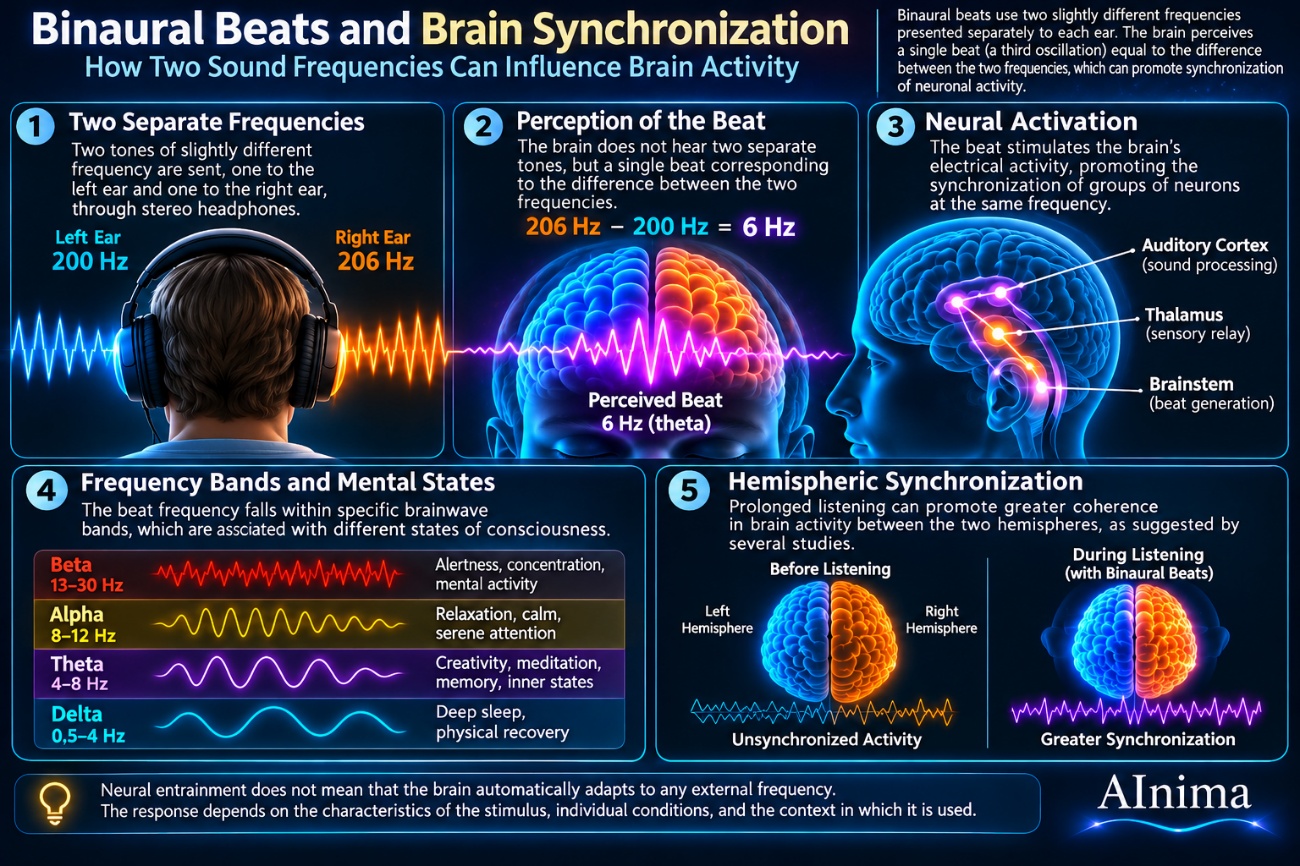
This frequency falls within the theta band, which is why researchers have questioned whether binaural beats may influence brain activity, relaxation, attention, or other mental states.
Understanding this relationship means exploring a field where perception, neuronal activity, and consciousness intersect, while distinguishing between possibilities that are already supported by scientific evidence and hypotheses that still require further investigation.
3. Robert Monroe: From Sound Experimentation to the Exploration of Consciousness
The story of Robert Monroe represents a fundamental chapter in the empirical investigation of altered states of consciousness. His journey began in the 1950s when, during experiments related to learning during sleep (hypnopaedia), he began reporting unusual experiences occurring in the transitional state between wakefulness and sleep.
These experiences led him to become interested in the mechanisms of consciousness and the possibilities offered by acoustic stimulation. Monroe began asking himself a specific question: was it possible to use sound not merely to relax the mind, but also to guide it toward different states of attention and awareness?
His research gradually developed through experimentation with sound frequencies, audio recordings, and relaxation techniques. A central element became the use of binaural beats, which Monroe incorporated into complex sound compositions. This work gave rise to Hemi-Sync (short for Hemispheric Synchronization).
The Principle of Hemispheric Synchronization
Monroe's hypothesis was that certain combinations of acoustic stimuli could promote greater coordination of electrical activity between the two cerebral hemispheres, drawing on the principle of the Frequency Following Response (FFR).
The term Hemi-Sync referred precisely to this possibility: creating conditions in which the activity of both hemispheres could exhibit greater coherence and phase synchronization.
To develop the method, the Monroe Institute's research team used EEG monitoring, participant observations, and combinations of sound stimuli. The aim was to identify acoustic configurations associated with particular subjective experiences.
The system was not limited to a single binaural beat: the recordings included overlapping frequencies, music, pink noise, natural sounds, and guided vocal instructions. In this way, a complex acoustic environment was created, intended to promote relaxation, focused attention, and inner exploration.
Monroe did not regard these experiences as mere relaxation. He sought to map different levels of awareness, which he called Focus Levels.
The Focus Levels: A Map of States of Consciousness
In Monroe's system, the Focus Levels represented different subjective states of perception. They were not intended as simple EEG frequency bands, but rather as experiential categories describing non-ordinary modes of attention.
Among the main stages of this journey are:
Focus 10 – Mind Awake, Body Asleep: a state in which a person maintains clear awareness while the physical body enters a deeply relaxed, sleep-like condition.
Focus 12 – Expanded Awareness: a condition in which the field of awareness expands beyond the boundaries of ordinary sensory attention.
Focus 15 – No Time: a state characterized by the suspension of the linear perception of time.
Focus 21: a condition that Monroe associated with the exploration of levels of reality beyond ordinary space-time references.
These designations belong to the experiential model developed by the Institute and do not constitute universally recognized neurological categories. Their significance lies in the attempt to organize and make certain subjective experiences repeatable through structured audio protocols.
What Does Scientific Research Reveal?
Monroe's work did not remain confined to informal accounts. Over time, several scientific contributions have been published to investigate the effects of technologies based on binaural beats and Hemi-Sync.
One of the most significant historical references is the work of F. Holmes Atwater, head of research at the Monroe Institute, published in 1997 in the Journal of Scientific Exploration under the title Accessing Anomalous States of Consciousness with a Binaural Beat Technology. Atwater described a multifactorial approach combining binaural stimulation, partial sensory deprivation, guided relaxation, and focused attention to influence the brain's reticular activating systems.
Another noteworthy study was conducted by C. P. Johnson and M. A. Persinger (1994, Perceptual and Motor Skills). The researchers examined the subjective responses of participants exposed to Hemi-Sync recordings, identifying, under certain conditions, pronounced sensations of a "perceived presence" and alterations in the sense of self. They hypothesized that these experiences might involve interactions with neuroelectrical processes in the temporoparietal regions.
It is important to emphasize that these studies investigate subjective responses and their neurophysiological correlates, but do not provide evidence for the existence of out-of-body phenomena or the physical separation of consciousness from the body. Furthermore, since Hemi-Sync technology combines several elements simultaneously—including frequencies, voice guidance, and pink noise—it is difficult to attribute the observed effects exclusively to binaural beats.
4. Artificial Intelligence: Designing the Soundscape of the Mind
The New Frontier: From Passive Listening to Personalized Stimulation
Artificial intelligence introduces a possibility that sets today's technologies apart from Monroe's early experiments: the ability to process large amounts of data, recognize recurring patterns, and adapt sound stimuli to individual parameters.
Through signal-processing algorithms and machine learning models, it is possible to modify numerous characteristics of an acoustic experience, including frequency, intensity, rhythm, duration, modulation, and sound composition.
This opens the door to systems capable of going beyond the simple playback of an audio track. In the future, an intelligent system could analyze a listener's physiological responses and progressively adjust the stimulus based on the data collected.
A concrete example is Closed-Loop Acoustic Stimulation. In this approach, the system records brain activity through electroencephalography (EEG), identifies specific characteristics of neuronal oscillations, and synchronizes the delivery of sounds with particular phases of their ongoing activity.
In 2024, a study published in the journal eNeuro by Harlow and colleagues demonstrated the feasibility of this approach using individual alpha frequency and the phase of brain oscillations to time acoustic stimuli. The researchers observed different EEG responses depending on when the sound was presented. This is an important finding because it shows that sound stimulation can be timed according to the individual neurophysiological characteristics of each person.
When Artificial Intelligence Meets Neuroscience
It is important to distinguish between two applications that are often confused.
The first concerns sound generation and personalization: artificial intelligence can create compositions, select frequencies, and modify acoustic sequences based on predefined criteria or individual preferences.
The second is more complex: it involves using a person's physiological signals to adapt the stimulus in real time. In this case, it is no longer simply the listener adapting to the sound sequence; rather, the system itself modifies its behavior in response to the listener's reactions.
It is precisely this second possibility that makes the intersection of AI and neuroscience particularly interesting.
A critical review published in 2026 in Frontiers in Human Neuroscience, focusing on AI-generated music and personalized sound interventions, analyzed 21 studies involving at least 1,005 participants in total. The authors distinguish between different forms of algorithmic personalization and report particularly promising findings in systems that incorporate neurophysiological feedback. However, they also highlight significant limitations: generally small sample sizes, a lack of independent replications, and an overall quality of evidence that remains very low.
This means that we are looking at an evolving field of research, not yet a technology capable of controlling states of consciousness at will.
From Frequency to Information: A New Perspective
We can now return to the initial question: what does a frequency really represent for the brain?
Sound is not merely a vibration that reaches the ear. It is a physical stimulus that is transformed by the auditory system into neural signals, which are then processed through distributed neuronal networks. The temporal and spectral characteristics of a stimulus contribute to the way the brain encodes and interprets information.
In this sense, sound can be understood as a medium through which information is transmitted to the nervous system.
Artificial intelligence could make it possible to study these interactions with greater precision, identifying which sound characteristics produce specific responses and which configurations prove more effective for particular experimental objectives.
This does not mean that a frequency contains a code capable of directly altering reality, but rather that the temporal and physical structure of a stimulus can influence the way the nervous system processes information.
This is an important distinction because it allows us to keep the discussion open without attributing properties to technology that have not yet been scientifically demonstrated.
A New Possibility for Exploring Consciousness
The journey that began with Monroe's experiments now takes on an entirely different technological perspective.
From sound recordings and binaural beats, we have arrived at systems capable of analyzing biological signals, processing neurophysiological data, and adapting stimuli according to individual responses.
The combination of neuroscience and artificial intelligence could therefore offer new tools for investigating the relationship between neuronal activity, perception, and states of consciousness.
One fundamental question remains: if we can learn to recognize and influence some of the rhythms that accompany our brain activity, how far can we go in understanding the mechanisms that give rise to our conscious experience?
This is one of the questions that runs throughout the journey of AInima: exploring the boundary between the biological mind, technology, and consciousness, without confusing what we can measure today with what we have yet to understand.
Comments
Leave a comment